

-
- No Comments
- July 28, 2026

GSC Traffic Drop 2026: AI Overviews & How to Recover
Why Your Google Search Console Traffic Dropped in July 2026 (And How to Fix It)
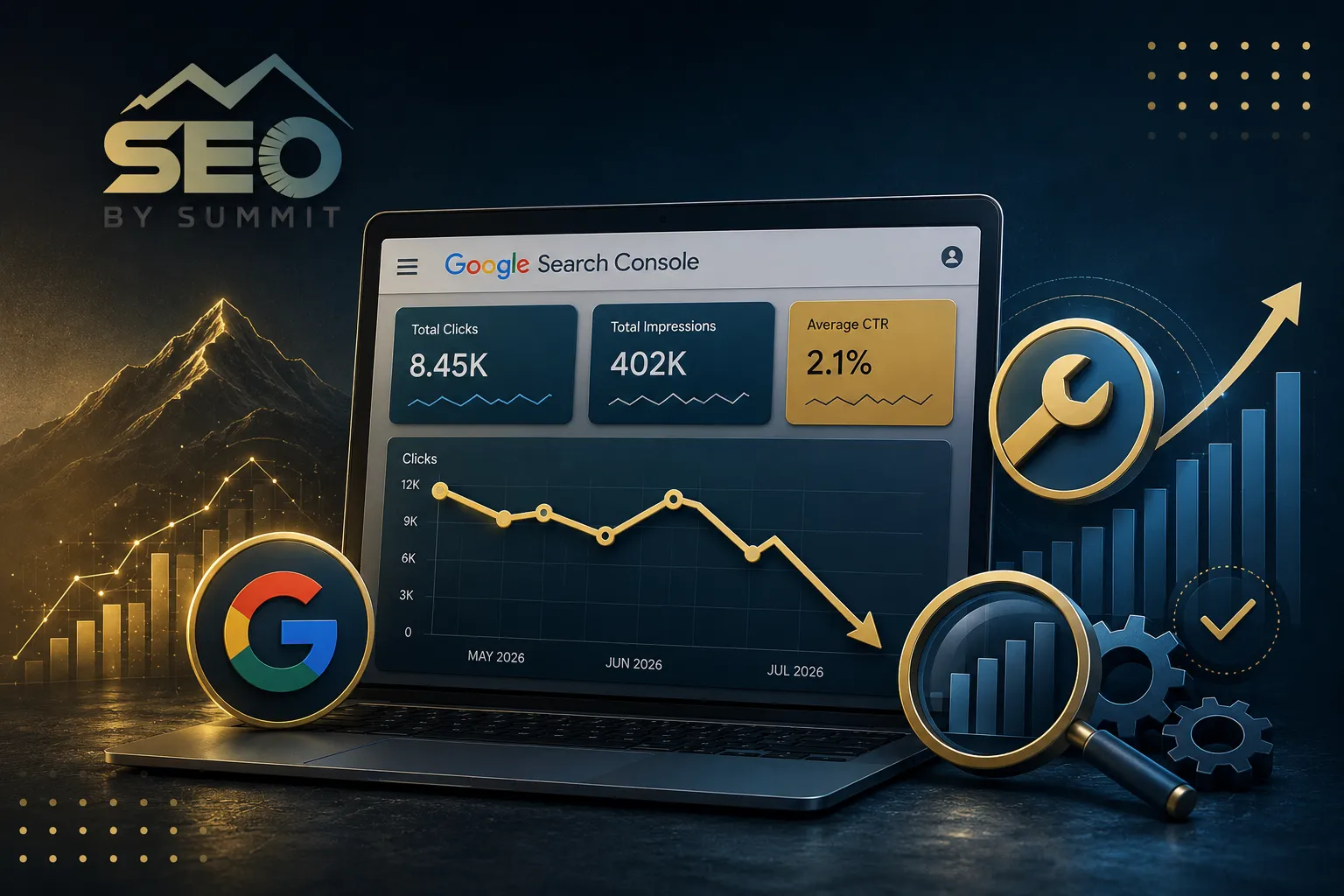
Noticing a sudden GSC traffic drop in July 2026? You’re not alone—and in many cases, it’s not “just seasonality.” As AI-driven SERP (Search Engine Results Page) features expand, many small businesses are seeing an impression-to-click gap widen even when their rankings look perfectly stable.
In fact, industry data shows that nearly 60% of Google searches now end without a click to a website (SparkToro, 2024). That “zero-click” dynamic has rapidly accelerated this month as Google’s AI Overviews and richer SERP modules answer user questions directly on the search page. If you are staring at a downward red arrow in your marketing dashboards, the most important thing to know is that your SEO isn’t necessarily broken; the way users interact with Google has fundamentally changed.
This guide breaks down the most common reasons a Google Search Console traffic drop is happening right now—especially AI Overviews’ zero-click impacts—plus a step-by-step fix plan. You’ll learn how to diagnose whether it’s CTR (Click-Through Rate) loss, query mix shifts, indexation problems, or a search algorithm update in July 2026, and exactly what to do next to protect your revenue.
What’s Different in July 2026: AI-First SERPs and a Bigger “Impression-to-Click” Gap
In 2026, the biggest “hidden” driver of SEO traffic loss is that visibility no longer guarantees visits. Google’s AI-powered results frequently satisfy a user’s intent directly in the SERP—especially for informational queries. This creates an organic CTR decline even when your overall impressions are rising.
AI Overviews and the Zero-Click Effect
AI Overviews (and related AI answer modules) compress the buyer’s journey: users get summaries, steps, and “best options” without ever needing to click a blue link. This aligns with the broader industry trend where roughly 58.5% of U.S. searches and 59.7% of EU searches are now zero-click.
For small and medium-sized businesses, this often manifests in a very specific data pattern: your average position remains stable, your impressions are rising, but your clicks are trending down.
Google is Sending Less Traffic to the Open Web
Independent measurement continues to show that Google’s click share has been under intense pressure as SERP features expand. While organic search still drives approximately 53% of trackable website traffic on average, the landscape is shifting. When AI modules expand, your page’s “share of attention” still exists, but your actual “share of clicks” may not.
To navigate this, businesses must evolve from basic SEO to holistic Growth Marketing that captures audiences across multiple touchpoints.
Diagnose the Drop Correctly in GSC (Before You “Fix” the Wrong Thing)
The fastest way to waste weeks of effort is treating every single drop like a ranking penalty. In July 2026, a highly meaningful portion of “drops” are actually CTR compression, query mix shifts, or temporary tracking artifacts.
Here is the diagnostic sequence we use at SEObySummit for a clean, accurate root-cause read. (Not sure where your site stands? Request a Free Website Audit and our team will check for you).
Step 1: Confirm It’s Not a Reporting or Measurement Issue
Before panicking, check for known GSC data anomalies. Google frequently experiences processing delays. Look at the date of your drop—if it aligns exactly with a known GSC reporting outage, your traffic is likely fine; the data simply hasn’t caught up.
Step 2: Segment by Query Intent (Brand vs. Non-Brand)
Open GSC, navigate to Performance → Search results, and filter queries containing your brand name.
- If your brand clicks are stable but non-brand clicks fell off a cliff, you’re likely dealing with AI Overviews, SERP feature shifts, or broader competitive compression.
- If brand clicks are also dropping, you might be facing a broader algorithmic demotion or a seasonal decline in brand awareness.
Step 3: Identify Whether It’s Impressions Down, Clicks Down, or Both
This split determines your entire playbook moving forward. A drop in impressions means Google is showing your site less often. A drop in clicks (while impressions stay stable) means Google is showing you, but users aren’t clicking.
Top 5 Causes of a GSC Traffic Drop in July 2026
Below are the most common causes we’re seeing across small business sites this month, mapped to their specific GSC symptoms.
1) AI Overviews Stealing Informational Clicks (CTR down, impressions flat/up)
This is the classic 2026 pattern. Your pages still rank highly and show up frequently, but fewer users click because the AI Overview answers the question immediately. You’ll see CTR drop significantly on top-of-funnel queries like “how to,” “best,” “what is the cost of,” and “symptoms.”
2) SERP Feature Crowding (Positions “unchanged,” clicks down)
Even without AI Overviews, features like “People Also Ask,” interactive video packs, sponsored product grids, and local map packs can push traditional organic listings far down the visual hierarchy. The result is an organic CTR decline without a dramatic average position change.
3) Indexing or Canonicalization Drift (Impressions and clicks down)
This is common after website updates, especially in WordPress or Shopify. Routine background code updates, parameter handling, or internal linking changes can cause Google to drop pages from the index. You’ll often see a sudden rise in “Duplicate, Google chose different canonical” errors in your GSC Indexing reports.
4) Content Decay + Faster Competitor Refresh Cycles (Impressions down slowly over weeks)
In 2026, “freshness” is about actual usefulness, not just updating the published date on your blog. If competitors add first-hand insights, custom visuals, transparent pricing, or updated FAQs, they may take your market share over time without a formal algorithm update occurring.
5) Demand Shifts and Seasonality (Query volume down)
Some industries naturally dip in July, such as education B2B, tax-related services, and certain B2C niches. The tell-tale sign here: your impressions fall across the board, including on your own branded queries, but your average rankings remain stable.
Benchmarks and Patterns: What the Data Shows
If your July 2026 drop is driven by SERP changes, your GSC charts will likely match one of these patterns.
| GSC Pattern (July 2026) | Most Likely Cause | First Fix to Try | Expected Time to Movement |
| Impressions ↔ / Clicks ↓ / Avg Position ↔ | AI Overviews & zero-click crowding | Rewrite titles/meta for higher “value promise”; target alternative intents. | 7–21 days |
| Impressions ↓ / Clicks ↓ / Avg Position ↓ | Ranking loss (content quality or competitor outranking) | Content refresh + internal link upgrades + topical consolidation. | 2–8 weeks |
| Impressions ↓ sharply / Pages dropping | Indexing or canonicalization issue | Check Indexing errors; validate fixes; resubmit sitemap. | 3–14 days |
| Clicks ↓ mostly on mobile devices | Mobile SERP crowding + UX mismatch | Improve above-the-fold value; optimize for mobile intent. | 2–6 weeks |
How to Fix a Google Search Console Traffic Drop in 2026 (Action Plan)
Here’s a practical, step-by-step recovery plan that maps to the most common July 2026 causes—starting with the fastest wins.
1) Win Back CTR with “SERP-Forward” Rewriting
When the search engine answers the basic facts, you must earn the click by promising something the SERP cannot fully deliver. Update your meta titles and descriptions to highlight exclusive tools, transparent pricing, downloadable templates, or local availability. Example: Change “How to Fix a Leaky Pipe” to “How to Fix a Leaky Pipe (With 5-Minute Video Tutorial).”
2) Close the “Impression to Click Gap” with Content Upgrades
If traffic is dropping but you still have visibility, capture the users who do click. Use highly targeted lead magnets (checklists, calculators, industry reports) so that your remaining traffic still turns into owned-audience growth. This is where strategic Conversion Rate Optimization (CRO) becomes vital to ensure you optimize for actual revenue, not just vanity traffic.
3) Fix Indexing and Crawl Problems
If impressions fell sharply across the board, audit your technical health. Confirm your 301 redirects are working, ensure rel=canonical tags are consistent, and check that your internal links point to the preferred versions of your URLs.
4) Rebuild Authority Signals with Topical Clustering
Quality links and topical authority still matter immensely for ranking losses. Organize your content into logical clusters and support them with strong internal linking. For small businesses, even a handful of strong, highly relevant backlinks can outperform dozens of low-quality mentions.
What to Do If You Suspect a Search Algorithm Update in July 2026
Google rarely confirms every single change they make. In 2026, the ecosystem is shaped by continuous, AI-driven re-ranking rather than a single “big switch” being flipped. However, if your traffic fell off a cliff, you can treat “search algorithm update July 2026” concerns rationally with a controlled process.
How to Validate Update Impact (Without Guessing)
Don’t rely on industry chatter alone. Look closely at your GSC timeline. Did your traffic take a sharp, vertical nosedive around mid-July? Compare this exact date range against SEO weather tools like Semrush Sensor or MozCast. If the dates perfectly align with a massive spike in global SERP volatility, you were likely caught in an algorithmic shift. Next, check if the drop was sitewide (suggesting a domain-wide quality issue) or isolated to a few specific blog posts.
Recovery Strategy That Works (Even if the Update is Unclear)
When hit by an unconfirmed update, do not panic-redesign your website or blindly rewrite perfectly good content. Focus on Google’s core E-E-A-T principles (Experience, Expertise, Authoritativeness, Trustworthiness).
- Remove or consolidate unhelpful, thin, or purely AI-generated fluff pages.
- Add author bios and real-world, first-hand experience to your cornerstone content.
- Improve page experience, ensuring your site loads lightning-fast and is free of intrusive pop-ups.
Common Mistakes to Avoid
Many recoveries stall because teams respond emotionally without validating the cause. Avoid these frequent pitfalls:
- Treating a CTR drop like a ranking penalty and aggressively changing keywords.
- Disavowing backlinks unnecessarily when Google already ignores most spam links.
- Ignoring your brand positioning. Investing in Market Positioning Services can drastically improve your branded search demand, making you less reliant on generic, volatile keywords.
Frequently Asked Questions
Why did my Google Search Console clicks drop but impressions stayed the same in July 2026?
This usually points to an organic CTR decline, not a ranking collapse. AI Overviews and rich SERP features are answering the query directly. Start by segmenting queries and comparing CTR changes for informational vs. transactional intent.
How do I know if AI Overviews caused my GSC traffic drop?
Look for queries where impressions stayed flat or rose while clicks fell—especially “how to,” “best,” and comparison queries. Manually check those searches on mobile and desktop. If an AI Overview appears above your organic result, prioritize rewriting your titles to offer deeper value that AI can’t provide.
What’s the fastest way to fix a Google Search Console traffic drop?
The fastest wins typically come from improving titles/meta descriptions and aligning content to higher-intent queries. Snippet optimization can often restore traffic in 1–3 weeks. Pair that with strong internal linking to route your remaining traffic to high-converting service pages.
Should I update old content or publish new content to recover?
Do both, but in the right order. Refresh the pages that are already earning impressions first (they’re closest to recovery), then publish supporting cluster content. Updates must add real usefulness, not just a new “published on” date.
How do I reduce dependence on Google if zero-click keeps increasing?
Build an owned audience. Capture emails and use remarketing. Also, invest heavily in brand demand via social media, partnerships, and offline visibility to improve branded search volume, which is highly resistant to AI Overviews.
Conclusion: Your July 2026 GSC Traffic Drop is Solvable
In July 2026, many traffic drops are not an “SEO failure”—they’re simply the new reality of AI-first SERPs and shifting user click behavior. The businesses that recover the fastest treat Google Search Console like a diagnostic instrument, carefully identifying the root cause before executing targeted improvements instead of broad, panicked rewrites.
Next step: If you want professional eyes on your data, share your top 5 losing queries and the pages tied to them with our team. Contact SEObySummit today or view our Case Studies to see how we help clients map out 30-day recovery plans focused on the fastest CTR wins and the most valuable conversion paths.
